The technology works. Adoption doesn’t.
The product is right, the pilot succeeded, and the organization still will not move. Where the resistance actually sits, and what changes it.
Read →Chief Revenue Officer, VerAvanti · Author of An Outsider’s Playbook
When the technology works but the company is not yet built to scale it, boards bring me in to rebuild the organization, the commercial engine, and the capital strategy around it. Four decades, six industries operated from the inside, $95M+ raised across three continents.
SOFTWARE→MINING→CAPITAL→CYBERSECURITY→MEDTECH→AI
Bellevue, Washington · juan@juanvegarra.com

“Juan shares practical frameworks for identifying market shifts, communicating value, building enduring businesses, and leading through uncertainty… ideas here that are both insightful and immediately useful.”
Technology rarely fails on merit. It fails because the company around it stayed the size and shape it was when the technology was still an idea. Boards call me at exactly that moment — the asset is real, the market is real, and the organization is two years behind both.
Strengthen the enterprise first. Then accelerate growth.
The product is right, the pilot succeeded, and the organization still will not move. Where the resistance actually sits, and what changes it.
Read →Five people in the room, five diagnoses, no shared evidence. How to find the constraint before spending against the wrong one.
Read →When directors are working from different stories, governance stalls quietly. How to converge a board without flattening dissent.
Read →The numbers are defensible and the meetings still end politely. Where investor narratives break, and how to rebuild one that closes.
Read →Every one of these is written out in full, free, and usable without me. How I work →
The method did not change when the industry did. This is what I actually do, in the order I do it.
See the reorder the insiders are too close to notice, while a contrarian read still costs nothing but conviction.
Win the room that was not built for you, by leading with the outcome rather than the credential.
Build what cannot be copied, because a win you cannot defend is only a head start.
Scale past yourself. Prove before pouring, and build a team that runs when you are not in the room.
Twenty-two prompts across two tools — and, with each one, a standard for judging what the AI hands back.
Stock Diligence. Eleven prompts that pressure-test a company before you buy it. The first treats your business and your portfolio as a single balance sheet, because if you own a company your largest position is not in your brokerage account.
Retirement. Eleven prompts that build the plan in the order the decisions actually arrive. The first values what you cannot sell — founder equity, a private stake, a stake with no market — because that is the number every other calculation runs on, and it is usually the one nobody checks.
No signup. No email. They are a gift.
Six industries, no incumbent credentials in any of them, the same operating system each time. This is the claim above, shown rather than asserted.
The essay walks through why cleared devices sit unused, and what adoption actually requires: workflow fit, reimbursement, and a champion inside the room.
Read →Trust is earned through augmentation, evidence, and the discipline to let the professional remain the author of the decision.
Read →The book's argument in one line: the outsider's real advantage is permission to reorder assumptions the incumbents can no longer see.
Read →Government permits are theater. Community control is real. What losing high-potential geological sites in Peru taught me, and why data center operators are about to learn it the same way.
Read →Every founder’s first corp dev meeting looks like a partnership discussion. It rarely is.
Read →Mining, SaaS, biotech, MedTech. Four industries, four cycles, one underlying mechanic.
Read →What CMS just did to the fast track, and what it means for founders raising on a pathway that no longer exists.
Read →The generalist is not a compromise. The generalist is an edge.
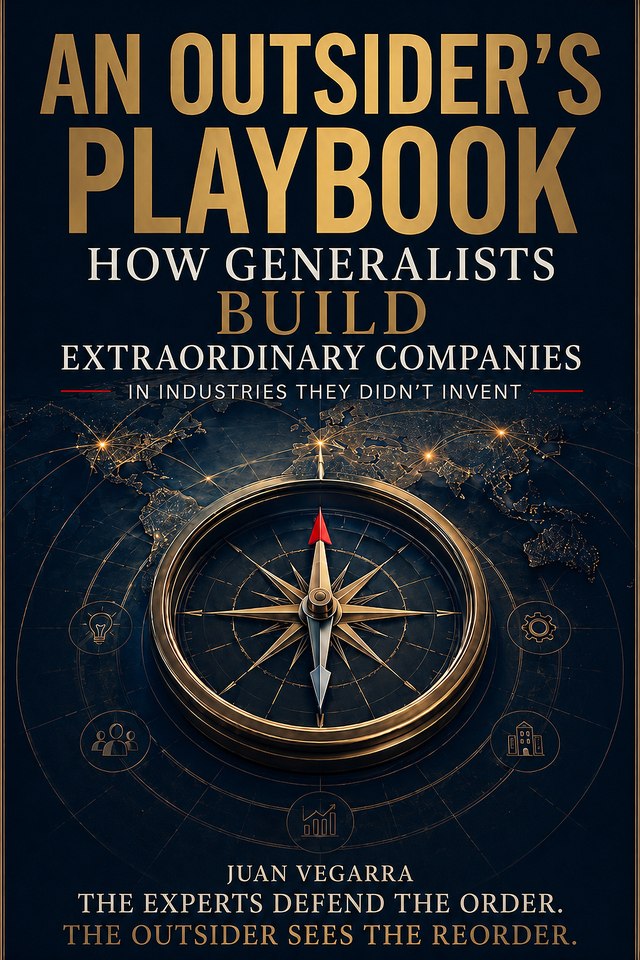
An Outsider’s Playbook is twenty short chapters on building enterprise value in industries I did not come from. Each one closes with an operating principle you can use on Monday.
Also in Spanish as El Manual del Outsider.
Everything here starts as a conversation on LinkedIn, where about 15,000 people follow along: an essay, an argument, a pattern someone pushes back on. This site is where those conversations get room to breathe. The best way to be part of it is to follow along and disagree with me in public, where everyone learns something.
And when a question needs more privacy than a comment thread, the inbox in the footer is open. It works in English or Spanish.
One essay most weeks on building companies, raising capital, and commercializing technology in markets that demand evidence.