Frameworks

Mental models, drawn.

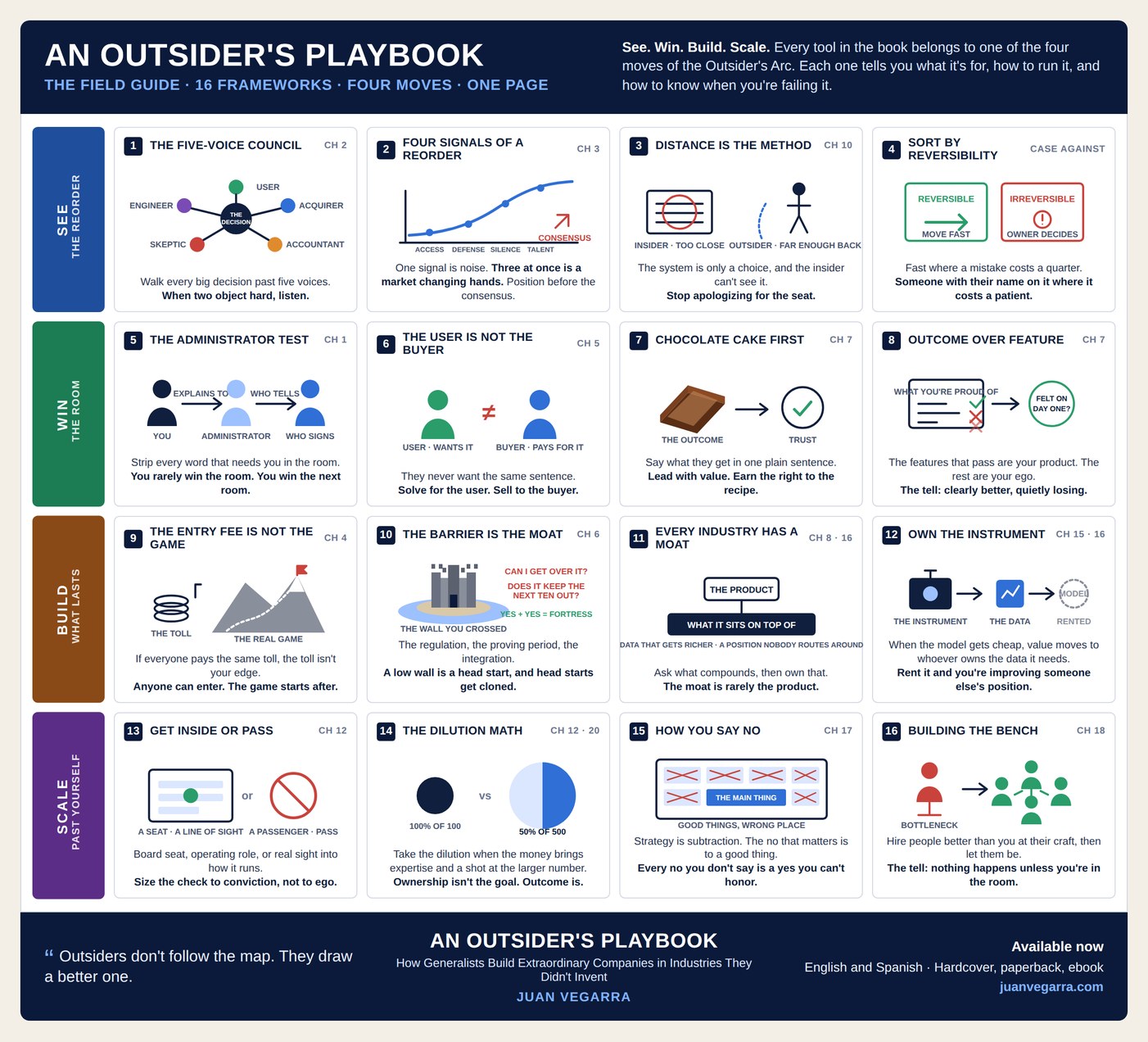
The essays argue. These are the models the arguments leave behind: compact, visual, and built to be reused on your own problems. Take them. Attribution appreciated, never required.

The working set

Growing with the library
Value creation

The MedTech Staircase

Regulated-market value does not climb a slope. It climbs a staircase: long flat treads of invisible work punctuated by sharp risers when a milestone lands. Judge a company by which riser is coming, not which tread it stands on.

From the essay at VerAvanti Insights →
Defensibility

The Sensor Plus the Loop

A dataset is a snapshot that decays. A moat is a proprietary input nobody else can capture, feeding a loop that compounds with every use. Volume helps and uniqueness helps, but only compounding widens the gap on its own.

Read The Data Moat Nobody Has →

Diagnostics

The Ninety-Day Test

If your team stopped touching the product for ninety days, would it still get better on its own? Yes means a flywheel. No means a dataset with good marketing. Run the test before an investor runs it for you.

Read The Data Moat Nobody Has →

Capital & regulation

Predicate Inheritance

A 510(k) predicate is not paperwork. It decides the codes, bundles, and payer precedent a device steps into on day one of clearance. Regulatory strategy is reimbursement strategy wearing a different hat.

Read Predicates Aren't Regulatory →

Scaling

Prove, Then Pour

You cannot buy your way past a sales motion you have not figured out. Prove the motion with a small team on real cases, then deploy capital hard behind what works. Patience earns the right to aggression.

Read Building the Commercial Engine →

Go-to-market

The Three Rooms

There is no single procedure room. The cath lab buys rhythm, the office-based lab buys economics, the high-acuity suite buys control. One product can be right for one room and actively wrong for another.

Read Go-to-Market Begins in the Procedure Room →